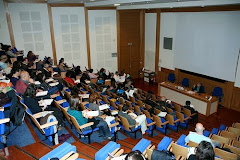
(9h-11h)
(salle 524 au 54, bd Raspail)
« Bienvenue » des organisatrices :
Stephanie Schwerter (EHESS /FMSH) et Jennifer K .Dick (EHESS)
et
Ouverture du colloque :
François Weil (Président EHESS) et Michel Wieviorka (Administrateur FMSH)
Séance Plénière :
Jean-René Ladmiral (Paris X)
« Sourciers et ciblistes, encore… »
BIO:
Jean-René Ladmiral: philosophe, germaniste, linguiste, traducteur et théoricien de la traduction. Après avoir enseigné à la Sorbonne et à l’Université de Heidelberg, il a fait de la recherche-action sur la psycho-sociologie de la communication dans les groupes bilingues (français-allemand). Ladmiral devient professeur à l’Université de Paris-X-Nanterre en 1968 où il y crée le Centre d’Etudes et de Recherches en Traduction (CERT). Actuellement, il enseigne la philosophie allemande, ainsi que la traductologie à Paris X et la traduction et la traductologie à l'I.S.I.T. (Institut Supérieur d'Interprétation et de Traduction) Pour une liste de publications, voir: http://www.u-paris10.fr/00334957/0/fiche___pagelibre/&RH=depphilorec
Pour plus (or Bios in English, or Deutch, click to see our posting on:) Invités d'honneur
dimanche 4 avril 2010


le 10 mai à 11h30: Atelier I : Socio-linguistique et traduction : techniques et outils (54, bd. Raspail)
(11h30-13h)
Atelier I :
Socio-linguistique et traduction :
techniques et outils.
(salle 524 au 54, bd Raspail)
Présidente : Dinah Ribard (EHESS)
How many languages, how many translations? Peter Caws (USA/UK. The George Washington University)
Prouver au travers d’exemples la rapidité de l’évolution linguistique du français contemporain, causée par le grand nombre d’emprunts récents d’anglais en français. Myriam de Beaulieu (France. Interprète à l’ONU à NYC)
The Traduxio Project: Translating Cultural Texts. Philippe Lacour (Belgique. Université Libre de Bruxelles / Centre Marc Bloch Berlin)
Abstracts /Résumés/ Zusammenfassungen
How many languages, how many translations? By Peter Caws.
BIOS:
Myriam de Beaulieu : née 1962. France. Interprète de conférence aux Nations-Unies, à New York (interprétation simultanée d'anglais en français et du russe en français) depuis 1993. Actuellement : doctorante de linguistique à l'Université d'Orléans sous la direction de Pierre Cadiot (dans le cadre d'un "congé" de recherche).
Atelier I :
Socio-linguistique et traduction :
techniques et outils.
(salle 524 au 54, bd Raspail)
Présidente : Dinah Ribard (EHESS)
How many languages, how many translations? Peter Caws (USA/UK. The George Washington University)
Prouver au travers d’exemples la rapidité de l’évolution linguistique du français contemporain, causée par le grand nombre d’emprunts récents d’anglais en français. Myriam de Beaulieu (France. Interprète à l’ONU à NYC)
The Traduxio Project: Translating Cultural Texts. Philippe Lacour (Belgique. Université Libre de Bruxelles / Centre Marc Bloch Berlin)
Abstracts /Résumés/ Zusammenfassungen
How many languages, how many translations? By Peter Caws.
This paper addresses three questions: what linguistic competence is required for scholarship in the humanities, what use can be made of translations, and what can (and cannot) be learned from translations without a full knowledge of the source language. When Troubetzkoy wrote his Grundzüge der Phonologie he wanted an empirical base of 100 languages for comparative purposes. He admitted that he only knew 33, and had to have recourse to informants for the other 67. We may admire but need not envy such prodigious linguistic competence. Even Troubetzkoy needed a translator for the 34th language. If there are 6000 languages in the world the difference between not knowing 5967 and not knowing 5999 seems minimal. Nevertheless we rightly regard any monolingual scholar as linguistically deficient. Some might argue that sooner or later major texts become available in translation. If I can read Flaubert in the original, but not the Lady Murasaki, then I can read the latter only in translation. If there is no drawback to not knowing one language, why should there be any drawback to not knowing another? I distinguish three levels of textual linguistic competence, and argue that without competence at the highest level in at least one language other than that of origin the scholar cannot fully appreciate what is involved in translation, and what risks are run in depending on it. But there are also distinguishable levels of competence in translation, and much can be learned from comparing versions by different translators even with lesser competence in the source language. The minimal answer to the questions of my title is therefore, in each case, two. Between two and 33 there is room for debate. The questions are complementary, and the justification of these answers has implications for scholarship and for postgraduate education.
Prouver au travers d’exemples la rapidité de l’évolution linguistique du français contemporain, causée par le grand nombre d’emprunts récents d’anglais en français. Myriam de Beaulieu.
Il semble qu’il existe deux types contraires de phénomènes dans l’évolution d’une langue. Le premier phénomène est très lent: c’est le processus de formation des expressions idiomatiques, forgées au fil du temps, c’est le processus d’assimilation des emprunts, c’est la formations d’expressions propres à une langue. Et, à l’opposé, on constate aujourd’hui un deuxième phénomène, très rapide: l’apparition récente et en masse, d’emprunts anglais appelés « anglicismes ». On le constate dans différentes langues (russe,…), mais nous nous en tiendrons essentiellement aux anglicismes en français dans notre étude. J’essaierai d’expliquer des expressions en anglais et en français, issues d'emprunts ou non, apparues au fil du temps, en décrivant leurs origines culturelles possibles. Par exemple, les expressions idiomatiques « a white elephant » ou des emprunts « juggernaut » ou un « pundit » témoignent du passé colonial du Royaume Uni en Inde. En revanche, "être dans le pétrin » renvoie à la tradition culinaire française, et en anglais peut se traduire par « to be in hot water ». Il semble que pour ce pays insulaire qu’est la Grande Bretagne, l’ « eau » revient souvent dans les expressions idiomatiques. La tradition française du pain, expliquerait l’importance du pain dans les expressions idiomatiques françaises. J’essaierai d’expliquer un grand nombre d’expressions, en décrivant leurs origines culturelles possibles. Le but est de prouver qu’une langue évolue au fil des siècles et que donc, des emprunts en masse en un laps de temps très court, doivent inciter à la prudence et à la réflexion. Nous essaierons de comprendre les causes (en fonction des situations d'activité langagière notamment), et, nous essaierons d'expliquer les conséquences (idéologiques, culturelles...) de ces anglicismes récents et en masseau travers de nombreux exemples. Nous étudierons des cas ou la connaissance de l'anglais est indispensable pour rétablir la charge sémantique de l'énoncé francophone. Les exemples sont nombreux: "être sous contrôle" pour "être maîtrisé...", "booster" pour "relancer la croissance",... "vendre" une idée pour "convaincre"..., "politiquement correct" pour "de bon aloi/ton ou orthodoxe"...etc. Notre but est de favoriser une prise de conscience de ce deuxième phénomène parmi les locuteurs francophones pour qu'ils le maîtrisent et ne le subissent pas.
The Traduxio Project: Translating Cultural Texts. Philippe Lacour.
Application : http://traduxio.hypertopic.org/
Site d'information technique et générale : http://traduxio.sourceforge.net/
Présentation des partenaires : https://sourceforge.net/apps/wordpress/traduxio/
Application : http://traduxio.hypertopic.org/
Site d'information technique et générale : http://traduxio.sourceforge.net/
Présentation des partenaires : https://sourceforge.net/apps/wordpress/traduxio/
Traduxio is a free, open source, web based, collaborative, and computer assisted translation tool. It is developed with innovative technology (Translation Memory device) and especially designed to tackle the challenges of cultural (non commercial, non repetitive) texts. Inspired by the strong collaborative spirit of the Web 2.0, and available to different audiences, the software has the vocation to become a mechanism of general interest. It should thereby be a major mechanism in the promotion of the common good, guided by a logic of collaboration and mutualization (gradual feeding of the database). Ultimately, Traduxio is also designed to encourage the diversification of language learning (in particular the learning of a wider range of languages) and to promote a reappraisal translation (as a professional skill) especially in research activities. Traduxio uses Translation Memory technology in an alternative way. The originality of the software resides in certain of its functionalities – besides the already mentioned ones (freeware, open source, collaborative and designed to cultural texts). Whereas traditional TMs are limited to two languages (the source / the target), Traduxio enables the comparison of different versions of the same text. A translated text is in effect not considered as an independent segment, but rather as a version of the initial text in another language. Traduxio offers moreover a better management of the translation context, for proposes a contextualized classification of the source (i.e. classification of the text according to the history, genre, author, etc.). Thanks to this relevant classification device, information can be more easily assessed and treated, thereby helping users finding the appropriate translation for particular words, expressions, and so forth.
BIOS:
Peter Caws: studied physics in London and philosophy at Yale. His early work in the philosophy of the natural sciences was followed by specialization in continental philosophy, with major publications on Sartre (1979) and the structuralists (1988). Returning to the philosophy of science, but under a wider conception, he was instrumental in founding the doctoral program in the Human Sciences at the George Washington University, where he has been University Professor of Philosophy since 1982. He translated Bochenski’s Die zeitgenossischen Denkmethoden and articles on the translation of Feuerbach and of Wittgenstein. He has an abiding interest in the importance of good translations and the unhappy effects of bad ones. For more, see his University homepage, with complete listing of books plus a selected list of article publications.
Myriam de Beaulieu : née 1962. France. Interprète de conférence aux Nations-Unies, à New York (interprétation simultanée d'anglais en français et du russe en français) depuis 1993. Actuellement : doctorante de linguistique à l'Université d'Orléans sous la direction de Pierre Cadiot (dans le cadre d'un "congé" de recherche).
Philippe Lacour : Ancien élève de l’ENS Paris, Philippe Lacour est agrégé et docteur en philosophie (Université Aix-Marseille 1). Ses travaux portent sur la rationalité pratique, au croisement de la philosophie du langage, de l’épistémologie des sciences de la culture, et de la théorie du droit. Il est actuellement post-doctorant à l’Université Libre de Bruxelles (Centre de Théorie Politique) et rattaché au Centre Marc Bloch de Berlin. Il collabore à certains projets du laboratoire Tech-Cico de l’Université de Technologie de Troyes et s’intéresse à l’appropriation des nouvelles technologies par les sciences sociales et les humanités.
le 10 mai à 11h30: Atelier II : De l’usage de la traduction dans la culture de masses (54, bd. Raspail)
(11h30-13h)
Atelier II :
De l’usage de la traduction dans la culture de masses
(salle 241 au 54, bd. Raspail)
Présidente : Anne-Marie Thiesse (ENS)
Globalisierung vs. Länderspezifik im massenmedialen Raum. Die deutsche und französische Anzeigenwerbung der Gegenwart im Spannungsfeld von Standardisierbarkeit und Kulturspezifizität. Nadine Rentel (France. Paris IV / DAAD)
Traductions Sociales: le double défi du conflit des représentations. Salah Basalamah (Canada. Université d’Ottawa)
Chinese Subtitles Lost in Translation: Dubbing, loss of identity, multilingualism in post-colonial Chinese countries as a basis for identity. Henry Leperlier (France. Dublin Institute of Technology)
Abstracts /Résumés/ Zusammenfassungen
Chinese Subtitles Lost in Translation: Dubbing, loss of identity, multilingualism in post-colonial Chinese countries as a basis for identity, by Henry Leperlier.
Atelier II :
De l’usage de la traduction dans la culture de masses
(salle 241 au 54, bd. Raspail)
Présidente : Anne-Marie Thiesse (ENS)
Globalisierung vs. Länderspezifik im massenmedialen Raum. Die deutsche und französische Anzeigenwerbung der Gegenwart im Spannungsfeld von Standardisierbarkeit und Kulturspezifizität. Nadine Rentel (France. Paris IV / DAAD)
Traductions Sociales: le double défi du conflit des représentations. Salah Basalamah (Canada. Université d’Ottawa)
Chinese Subtitles Lost in Translation: Dubbing, loss of identity, multilingualism in post-colonial Chinese countries as a basis for identity. Henry Leperlier (France. Dublin Institute of Technology)
Abstracts /Résumés/ Zusammenfassungen
Globalisierung vs. Länderspezifik im massenmedialen Raum. Die deutsche und französische Anzeigenwerbung der Gegenwart im Spannungsfeld von Standardisierbarkeit und Kulturspezifizität. Nadine Rentel.
Der Bereich der Massenkommunikation umfasst viele Bereiche, z.B. Botschaften in Fernsehen, Radio, in der Presse oder im Internet. Die Werbekommunikation als Gegenstand der vorliegenden Untersuchung ist in diesem Kontext als ein Teilgebiet der massenmedialen Kommunikation anzusehen. Der Werbediskurs ist allgegenwärtig ist und berührt aufgrund der Kommunikation von Werten und Emotionen die interkulturelle Ebene in besonderer Weise. Werbekommunikation umfasst vier Formate: Anzeigen und Plakate im Printbereich, die Radiowerbung, Werbung im TV sowie die Realisierung in neuen medialen Gattungen, z.B. im Internet. Sie tritt somit in dynamisch-sequentieller Form (z.B. Fernseh- oder Kinospot) oder aber in statischer Form (Plakate oder Anzeigen) auf. Aus methodischen Gründen liegt der Schwerpunkt des Beitrags auf der Printwerbung. Ein Vergleich zwischen dem Werbediskurs in Frankreich und Deutschland erscheint aus mehreren Gründen relevant. Die interkulturelle Perspektive im Kontext der Analyse von Werbekommunikation geht davon aus, dass jede Form von Kommunikation kulturgebunden ist. Sie beschäftigt sich somit mit der Frage, ob es möglich ist, “globale” bzw. standardisierte Werbung zu betreiben, d.h. ein identisches Konzept in unterschiedlichen Kulturen zu verwenden, oder ob die Gestaltung von Werbeanzeigen kulturspezifische Besonderheiten berücksichtigt. Diese interkulturelle Fragestellung besitzt für die Werbetreibenden in Agenturen Relevanz, die Werbekampagnen für international (in diesem Fall in Deutschland und Frankreich) vertriebene Produkte und Dienstleistungen entwickeln müssen und sich daher als Spezialisten des deutschen und französischen Kulturraums ausweisen sollen. Bei der Konzeption von Werbekommunikaten müssen interkulturelle Unterschiede berücksichtigt werden, damit Werbung in einem international geprägten Kontext funktioniert. Es kann von entscheidender Bedeutung sein, sprachliche und bildliche Werbeaussagen adaptiv umzusetzen, das heißt kulturraumspezifische Besonderheiten im sprachlichen und/oder bildlichen Teil zu berücksichtigen, und nicht einfach 1:1 zu übernehmen oder zu übersetzen. Ausgehend von der Hypothese der kulturraumgebundenen Adaptation von Werbeanzeigen sind konkret zwei Fragen zu beantworten: Zum Einen muss geklärt werden, auf welchen Ebenen innerhalb der Werbeanzeige sich interkulturelle Unterschiede manifestieren (hierbei soll auch die visuelle Ebene berücksichtigt werden), bevor der Frage nachgegangen werden kann, welche formalen und sprachlich-stilistischen Merkmale (z.B. die Adressatenspezifik betreffend) sowie Kernaussagen (z.B. Herausstellen technischer Ausstattungsdetails vs. Ästhetik in der Automobilwerbung) charakteristisch für den französischen bzw. den deutschen Kulturraum sind und ob sich solche Merkmale überhaupt ausschließlich dem einen oder anderen Kulturraum zuweisen lassen. Die empirische Untersuchung basiert auf einem Korpus von jeweils ca. 100 deutschen und französischen Werbeanzeigen, die in den Jahren 2008 und 2009 in Publikumszeitschriften erschienen sind.
Traductions sociales : le double défi du conflit des représentations. Salah Basalamah.
Traditionnellement confinée dans le paradigme linguistique, la réflexion traductologique considère enfin aujourd’hui – et après plusieurs tournants déterminants de son évolution (Snell-Hornby) – le domaine des sciences sociales comme un espace d’élaboration privilégié pour la traduction comme concept à la fois opératoire et heuristique. De fait, suite aux déconstructions de Benjamin, de Barthes, de Foucault, de Derrida et de Paz (entre autres), l’auctorialité n’est plus cette instance romantique et exclusive de production de sens, mais bien plutôt la fonction dématérialisée et redistribuée qui se voit désormais concurrencée par le discours second, que nous appelons « traduction ». Traduire est donc non seulement la posture discursive fondamentale de l’individu participant dans les sociétés toujours plus hétérogènes, mais elle représente également la condition même de l’action communicationnelle qui met aux prises les groupes socioculturels en conflit. En somme, on ne peut espérer désamorcer les conflits de représentations actuels qu’en se donnant les moyens de penser le processus de traduction des cadres de références respectifs des acteurs sociaux impliqués. À l’heure des débats sur les accommodements raisonnables (Québec), le voile intégral (France, Canada) et les minarets (Suisse), la question identitaire s’impose comme un projet politique à contre-courant des évolutions sociales et en lutte avec les cadres juridiques et constitutionnels de nombre de démocraties. Du sentiment de rejet socio-économique à celui de la stigmatisation médiatique en passant par l’incompréhension ou – au mieux – le malentendu plus ou moins entretenu sur la reconnaissance citoyenne, les musulmans occidentaux (d’Europe et d’Amérique du Nord) s’interrogent sur les possibilités d’une intégration, cette fois-ci, symbolique et représentationnelle A) de l’environnement culturel dominant dans un système identitaire (musulman occidental) reterritorialisé, encore en élaboration et B) de leur cadre de référence en cours d’adaptation dans l’espace socioculturel plus large. Ainsi, que ce soit dans le sens « intra-communautaire » ou « inter-communautaire », la traduction sociale des représentations conflictuelles dans l’espace du discours, des images et des imaginaires se fait désirer. Or quelle est la légitimité de la pensée traductive à se préoccuper de questions sociales ? En quoi l’extension du champ d’intérêt de la traduction au domaine social peut-elle s’avérer porteuse d’un horizon conceptuel nouveau à la fois pour la traductologie et pour les sciences sociales ?
Traditionnellement confinée dans le paradigme linguistique, la réflexion traductologique considère enfin aujourd’hui – et après plusieurs tournants déterminants de son évolution (Snell-Hornby) – le domaine des sciences sociales comme un espace d’élaboration privilégié pour la traduction comme concept à la fois opératoire et heuristique. De fait, suite aux déconstructions de Benjamin, de Barthes, de Foucault, de Derrida et de Paz (entre autres), l’auctorialité n’est plus cette instance romantique et exclusive de production de sens, mais bien plutôt la fonction dématérialisée et redistribuée qui se voit désormais concurrencée par le discours second, que nous appelons « traduction ». Traduire est donc non seulement la posture discursive fondamentale de l’individu participant dans les sociétés toujours plus hétérogènes, mais elle représente également la condition même de l’action communicationnelle qui met aux prises les groupes socioculturels en conflit. En somme, on ne peut espérer désamorcer les conflits de représentations actuels qu’en se donnant les moyens de penser le processus de traduction des cadres de références respectifs des acteurs sociaux impliqués. À l’heure des débats sur les accommodements raisonnables (Québec), le voile intégral (France, Canada) et les minarets (Suisse), la question identitaire s’impose comme un projet politique à contre-courant des évolutions sociales et en lutte avec les cadres juridiques et constitutionnels de nombre de démocraties. Du sentiment de rejet socio-économique à celui de la stigmatisation médiatique en passant par l’incompréhension ou – au mieux – le malentendu plus ou moins entretenu sur la reconnaissance citoyenne, les musulmans occidentaux (d’Europe et d’Amérique du Nord) s’interrogent sur les possibilités d’une intégration, cette fois-ci, symbolique et représentationnelle A) de l’environnement culturel dominant dans un système identitaire (musulman occidental) reterritorialisé, encore en élaboration et B) de leur cadre de référence en cours d’adaptation dans l’espace socioculturel plus large. Ainsi, que ce soit dans le sens « intra-communautaire » ou « inter-communautaire », la traduction sociale des représentations conflictuelles dans l’espace du discours, des images et des imaginaires se fait désirer. Or quelle est la légitimité de la pensée traductive à se préoccuper de questions sociales ? En quoi l’extension du champ d’intérêt de la traduction au domaine social peut-elle s’avérer porteuse d’un horizon conceptuel nouveau à la fois pour la traductologie et pour les sciences sociales ?
Chinese Subtitles Lost in Translation: Dubbing, loss of identity, multilingualism in post-colonial Chinese countries as a basis for identity, by Henry Leperlier.
This presentation will examine how dubbing in Hong Kong cinema imposed by regulations from Mainland China can serve to hide or even obliterate an original identity. A case in point can be made using the Johnnie To’s film, Breaking News /大事件. In Breaking News, Johnnie To presents us with a confrontation between the local Hong Kong police, speaking Cantonese and hostage taking gangsters who only speak Mandarin Chinese. Since China’s regulations prohibit the distribution and showing of films in Chinese Languages (so-called Chinese dialects), all the dialogue in the film is dubbed into Mandarin Chinese. This completely occults the linguistic divide between the police chief and the leader of the gangsters which turns very quickly into a symbolic battle of wits. It could be interpreted as a metaphor for the struggle between Hong Kongers striving to retain their identity after their return to China in 1997 by the UK government as both protagonists try, while trying to trick each other, to seduce their opponents. Another negative side of dubbing is the dubbing of Chinese Films into English: the popular historical martial arts film, Crouching Tiger Hidden Dragon, was dubbed into English for distribution in the West. In the Chinese speaking world, this film was the subject of considerable controversy since most actors, although having Cantonese as a mother tongue, spoke Mandarin with a strong Cantonese accent. Although many cinema goers were shocked to hear non-standard accents, it made realize part of the public that at the time of the film story, there were probably very few Mandarin Speakers who spoke, not only Mandarin, and if they did, it would have been with a strong regional accent. Finally, in Taiwanese cinema, an island state with three Chinese languages, Mandarin, Taiwanese / Minnan and Hakka. Practically all films, since the end of the 1990’s, portray characters who speak in any of these languages in accordance with their character or the given scene or setting. The problematics is that, contrary to what is sometimes done in some films in the west, subtitles practically never convey these linguistic differences (e.g. through differenct colours) which are essential in understanding not only the meaning but also the plot of movies such as Hou Hsiao-Hsien’s A City of Sadness. This film has dialogues or announcements in five languages: Classical Japanese, Modern Japanese, Mandarin, Taiwanese, Shanghainese.
BIOS:
BIOS:
Nadine Rentel : Après ses études en romanistique et en linguistique computationnelle aux universités de Duisburg et de Poitiers, Nadine Rentel a été responsable d’un projet de recherche avec le titre « Le discours universitaire allemand pour étudiants et chercheurs étrangers » à l’université de Duisburg. Depuis 2008 elle enseigne à l’université de Paris IV et coordonne le programme des lecteurs allemand en France au bureau parisien du DAAD. Ses recherches portent sur la linguistique comparée, le discours universitaire, la langue économique et le discours publicitaire.
Salah Basalamah : (Université d’Ottawa, Canada). Salah Basalamah est professeur agrégé à l’École de traduction et d’interprétation de l’Université d’Ottawa. Il est notamment l’auteur du Droit de traduire. Une politique culturelle pour la mondialisation, Presse de l’Université d’Ottawa et Artois Presses Université, 2009.
Henry Leperlier: Ceard-Teastas Gaeilge, has a D.U.E.L in English, German and Economics from the Université de Grenoble, a B.A. degree in Chinese Language, Literature and Civilization (Université de Montpellier), an MA and a PhD in Comparative Canadian Literature from the University of Sherbrooke, Québec, and a University Diploma in Chinese from the University of Montpellier. His MA thesis was on bilingual protagonists in the Canadian Novel; his PhD research focused on language planning while his dissertation was a comparative study of Canadian Science Fiction written in English and French. A former localisation software engineer, he is currently doing research in Chinese language cinema for a PhD in Chinese at the Université Lyon III. He speaks and writes fluent Breton, Irish and Spanish, has lectured in Spanish and taught German and Irish. He has a good to average knowledge of Dutch, Catalan and Swedish. Other languages include Russian, Finnish, Creole and Italian. In 1993 he was awarded the National Award for journalistic work from an t-Oireachtas (1993) for his articles in Lá.
le 10 mai à 11h30: Atelier III : Traduire et interpréter l’Autre (54, bd. Raspail)
(11h30-13h30)
Atelier III :
Traduire et interpréter l’Autre
(salle 445bis au 54, bd. Raspail)
Présidente : Anne-Marie Picard-Drillien (AUP)
Penser la réception du néo-travaillisme dans la gauche socialiste française à l'aune du concept de traduction. Thibaud Rioufreyt (France. Institut des Etudes Politiques, Lyon)
Power, Indigenous Language and Medical Interpreters in Northern Canada, 1930-1970. Myra Rutherdale (Canada. York University)
Bridging Cultures: John Reed’s Translation of Le Vieux Nègre et la Médaille. Felix Awung (Lesotho. National University of Lesotho)
Jacques Ferron – both writer and translator. Angela Feeney (Irlande. ITT, Dublin)
Abstracts /Résumés/ Zusammenfassungen
Power, Indigenous Language and Interpreters: Approaching Colonial Encounters In Canada’s North, 1930-1970 by Myra Rutherdale.
This paper focuses on the experiences of Aboriginal Canadian interpreters/translators who worked in tandem with doctors and nurses in Aboriginal communities across Canada’s north in the period from 1930 to 1970. In Translation and Power Maria Tymoczko and Edwin Gentzler recognize the powerful position occupied by translators in the colonial process, especially in the making of knowledge and the creation of colonial citizenship: “translation has been a key tool in the production of such knowledge and representations,” they argue. Yet, it was not always the colonizers who had the power and knowledge. On both sides of the colonial divide, the role of the interpreter was vested with power. Sometimes, in fact, Aboriginal interpreters determined the parameters of the working relationship. The paper will make three interrelated arguments. First, it is apparent that the doctors and nurses who attempted to introduce westernized medicine to Aboriginal patients were dependent upon Aboriginal interpreters to carry out their work successfully, a dependency that often went unacknowledged. Secondly, interpreters were the quintessential people in between two cultures, and as such often felt compelled to protect both their own people and the newcomers. For example, they often changed the meaning of the sometimes harsh words used by nurses and doctors. Thirdly, a new understanding of the relationship between interpreters and newcomers has the potential to dislodge the traditional binary between the colonizer and the colonized. The proposed paper casts light on the place of translation within colonial and post-colonial contexts in which “the other” was being constructed and reconstructed. This paper will bring to the conference perspectives on shifting power dynamics based on representations of power and language within the interpreter’s role in Canada’s far north.
Bridging Cultures: John Reed’s Translation of Le Vieux Nègre et la Médaille. Felix Awung.
BIOS:
Atelier III :
Traduire et interpréter l’Autre
(salle 445bis au 54, bd. Raspail)
Présidente : Anne-Marie Picard-Drillien (AUP)
Penser la réception du néo-travaillisme dans la gauche socialiste française à l'aune du concept de traduction. Thibaud Rioufreyt (France. Institut des Etudes Politiques, Lyon)
Power, Indigenous Language and Medical Interpreters in Northern Canada, 1930-1970. Myra Rutherdale (Canada. York University)
Bridging Cultures: John Reed’s Translation of Le Vieux Nègre et la Médaille. Felix Awung (Lesotho. National University of Lesotho)
Jacques Ferron – both writer and translator. Angela Feeney (Irlande. ITT, Dublin)
Abstracts /Résumés/ Zusammenfassungen
Penser la réception du néo-travaillisme dans la gauche socialiste française à l'aune du concept de traduction. Thibaut Rioufreyt.
Travaillant sur la réception du néo-travaillisme britannique dans la gauche socialiste, le programme lancé par Pierre Bourdieu sur la circulation internationale des idées constitue l'une des approches les plus fécondes[1]. Toutefois, certains postulats présents dans la théorie bourdieusienne et repris dans les travaux qui s'y réfèrent sont problématiques[2]. Partant de la thèse selon laquelle les mécanismes à l'oeuvre dans la traduction au sens le plus restrictif (comme opération de transposition du sens d'un texte d'une langue à une autre) sont analogues aux mécanismes à l'oeuvre dans la circulation internationale des idées, je me propose donc, à travers un cas empirique, d'opérer un examen critique de certains postulats bourdieusiens et de montrer la fécondité du concept de traduction pour y pallier. Ma contribution portera sur deux questions connexes : la sociologie des acteurs (pensés non plus comme des intermédiaires mais comme des médiateurs) et les logiques de réception d'une idée (en ne réduisant pas les discours au statut de support expressif des positions sociales).
[1] BOURDIEU Pierre, « Les conditions sociales de la circulation international des idées », Actes de la recherche en sciences sociales, n° 145, décembre 2002, pp. 3-8.
[2] Voir notamment DEZALAY Yves & GARTH Bryant G., La mondialisation des guerres de palais. La restructuration du pouvoir d’État en Amérique latine. Entre notables du droit et « Chicago Boys », Paris, Le Seuil, 2002, et François DENORD, « Le prophète, le pèlerin et le missionnaire. La circulation internationale du néo-libéralisme et ses acteurs », Actes de la recherche en sciences sociales, n° 145, 2002, p. 9-20. Voir également HEILBRON Johan et SAPIRO Gisèle, « Pour une sociologie de la traduction : bilan et perspectives », version anglaise parue dans WOLF Michaela (dir.), Construction a Sociology of Translation, Benjamins Press, 2007, pp. 93-107.
Travaillant sur la réception du néo-travaillisme britannique dans la gauche socialiste, le programme lancé par Pierre Bourdieu sur la circulation internationale des idées constitue l'une des approches les plus fécondes[1]. Toutefois, certains postulats présents dans la théorie bourdieusienne et repris dans les travaux qui s'y réfèrent sont problématiques[2]. Partant de la thèse selon laquelle les mécanismes à l'oeuvre dans la traduction au sens le plus restrictif (comme opération de transposition du sens d'un texte d'une langue à une autre) sont analogues aux mécanismes à l'oeuvre dans la circulation internationale des idées, je me propose donc, à travers un cas empirique, d'opérer un examen critique de certains postulats bourdieusiens et de montrer la fécondité du concept de traduction pour y pallier. Ma contribution portera sur deux questions connexes : la sociologie des acteurs (pensés non plus comme des intermédiaires mais comme des médiateurs) et les logiques de réception d'une idée (en ne réduisant pas les discours au statut de support expressif des positions sociales).
[1] BOURDIEU Pierre, « Les conditions sociales de la circulation international des idées », Actes de la recherche en sciences sociales, n° 145, décembre 2002, pp. 3-8.
[2] Voir notamment DEZALAY Yves & GARTH Bryant G., La mondialisation des guerres de palais. La restructuration du pouvoir d’État en Amérique latine. Entre notables du droit et « Chicago Boys », Paris, Le Seuil, 2002, et François DENORD, « Le prophète, le pèlerin et le missionnaire. La circulation internationale du néo-libéralisme et ses acteurs », Actes de la recherche en sciences sociales, n° 145, 2002, p. 9-20. Voir également HEILBRON Johan et SAPIRO Gisèle, « Pour une sociologie de la traduction : bilan et perspectives », version anglaise parue dans WOLF Michaela (dir.), Construction a Sociology of Translation, Benjamins Press, 2007, pp. 93-107.
Power, Indigenous Language and Interpreters: Approaching Colonial Encounters In Canada’s North, 1930-1970 by Myra Rutherdale.
This paper focuses on the experiences of Aboriginal Canadian interpreters/translators who worked in tandem with doctors and nurses in Aboriginal communities across Canada’s north in the period from 1930 to 1970. In Translation and Power Maria Tymoczko and Edwin Gentzler recognize the powerful position occupied by translators in the colonial process, especially in the making of knowledge and the creation of colonial citizenship: “translation has been a key tool in the production of such knowledge and representations,” they argue. Yet, it was not always the colonizers who had the power and knowledge. On both sides of the colonial divide, the role of the interpreter was vested with power. Sometimes, in fact, Aboriginal interpreters determined the parameters of the working relationship. The paper will make three interrelated arguments. First, it is apparent that the doctors and nurses who attempted to introduce westernized medicine to Aboriginal patients were dependent upon Aboriginal interpreters to carry out their work successfully, a dependency that often went unacknowledged. Secondly, interpreters were the quintessential people in between two cultures, and as such often felt compelled to protect both their own people and the newcomers. For example, they often changed the meaning of the sometimes harsh words used by nurses and doctors. Thirdly, a new understanding of the relationship between interpreters and newcomers has the potential to dislodge the traditional binary between the colonizer and the colonized. The proposed paper casts light on the place of translation within colonial and post-colonial contexts in which “the other” was being constructed and reconstructed. This paper will bring to the conference perspectives on shifting power dynamics based on representations of power and language within the interpreter’s role in Canada’s far north.
Bridging Cultures: John Reed’s Translation of Le Vieux Nègre et la Médaille. Felix Awung.
The works of Ferdinand Oyono have become classics in the English speaking world thanks to translation. This demonstrates the enormous contribution translation can make and has made to literature in general and African literature in particular. However, even though much has been said and written about the success of these works, little credit has been given to the translators who have bridged the intercultural gaps to make these works available in English. It should be observed that translating African culture from one European language to another can be quite a challenging task, especially if the culture is foreign to the translator. This difficulty, as Bandia (1993) says, is due to the fact that cultural value systems are difficult to grasp as they are intricately woven into the texture of the native languages. Such a task is even more intriguing when dealing with African literature since the original text is in itself a form of translation, initially conceived in the African language of the author before being rendered into a European language. Looking at John Reed’s (1967) translation of Le vieux Nègre et la Médaille (1956), this paper seeks to examine how the translator has managed to overcome the obvious difficulties inherent in such a task, to pass across the cultural world view of Oyono into English. Given that literature portrays the norms, beliefs, and tradition of a particular society, the paper specifically examines the strategies used to translate the cultural bound terms of Oyono’s Bulu society into English. The questions that arise would seek to know the choices he makes, the reasons for them and how they conform to or conflict with relevant theories on the subject. Does the fact that he is working on what is already a translation make his task easier or more challenging? These are some of the questions this paper will be attempting to answer.
Jacques Ferron-both writer and translator, by Angela Feeney.
This paper proposes to examine issues of translation in the writing of Quebec writer Jacques Ferron. It is intended to examine the general issue of translation of his work into English against the backdrop of a French-English bilingual community. In addition this paper proposes to present Ferron as a translator within his own work and why he chose to act as translator and writer at one time. His work proves to be very interesting from the point of view of a writer himself translating across two ‘unequal’ cultures. In his novel ‘La nuit/ Ferron inserts a French translation of an English poem. In doing so, he draws the attention of the reader towards the act of translation itself and the role the translator plays in the transmission of culture. Ferron seems to force us to ponder such questions as what is the function of translation in a French-Canadian context and when translating what factors are at play in choosing what to translate and how to translate it. This aspect of Ferron’s writing is an excellent example of translation ‘within’. It is an excellent example of how writers can make comment on cultural issues not only through their writing but through the use of translation.
BIOS:
Thibaut Rioufreyt : Doctorant en science politique à l'Institut d'études politiques de Lyon, Thibaut Rioufreyt travaille dans le cadre de sa thèse sur la traduction du néo-travaillisme dans la gauche socialiste française. Ses recherches se trouvent ainsi à la croisée de la circulation internationale des idées, la socio-histoire des intellectuels, la sociologie du Parti socialiste et l'histoire des idées. Co-organisateur d'un séminaire de recherche intitulé sur « Perspectives critiques autour de la notion de champ dans la sociologie bourdieusienne » (http://triangle.ens-lsh.fr/spip.php?rubrique352), il a publié un article sur « Les mutations de la gauche contemporaine à l'aune du concept de social-libéralisme » (à paraître fin 2010 dans un ouvrage collectif sous la direction de Jean-Pierre Potier, Jacques Guilhaumou et Jean-Louis Fournier à ENS éditions, Lyon).
Myra Rutherdale: is an Associate Professor in the Department of History at York University in Toronto, Canada. She is the author of Women and the White Man’s God: Gender and Race in the Canadian Mission Field (2002). She co-edited Contact Zones: Aboriginal and Settler Women in Canada’s Colonial Past (2205) and edited Caregiving. On The Periphery: Historical Perspectives on Nursing and Midwifery In Canada (2010). She studies colonialism and is most interested in race relations in northern Canada, particularly relationships between Aboriginal people and newcomers to the north. Her particular focus is on Inuit interpreters.
Felix Awung: holds an MA in translation and currently teaches French language and translation theory and practice at the National University of Lesotho. He is also enrolled in a part–time PhD programme in translation studies at Wits University in Johannesburg, and his PhD focus is on the translation of African culture. Mr Awung has seven years of experience working as a language teacher/lecturer, and a freelance translator and interpreter. His preferred fields of research are cultural translation and sociolinguistics.
Angela Feeney: Lecturer in Humanities at the Institute of Technolgy Tallaght Dublin, Ireland, and a Member of the Franco-Irish Centre.
le 10 mai à 14h30: Atelier IV: Théories de la traduction : littérature, philosophie et socio-philosophie (54, bd. Raspail)
(14h30-16h)
Atelier IV :
Théories de la traduction :
littérature, philosophie et socio-philosophie.
(salle 524 au 54, bd Raspail)
Président: Pierre Judet de la Combe (EHESS)
Authoring Translations into Originals: The Accountability of Impossible Transmissibility in Expeditions of a Chimæra. Oana Avasilichioaei (Montreal, Canada. Auteur)
A Question of Timing: The “Last” work. (Barthes/Foucault). Kate Briggs (UK. Freelance translator)
Comment traduire Ronsard en allemand? Caroline Fischer. (France. Université de Pau)
Abstracts /Résumés/ Zusammenfassungen
Authoring Translations into Originals: The Accountability of Impossible Transmissibility in Expeditions of a Chimæra, by Oana Avasilichioaei.
A Question of Timing: The “Last” work, by Kate Briggs.
Comment traduire Ronsard en allemand ? Caroline Fischer.
Ronsard, un des plus importants poètes français dont l’œuvre influencera de nombreux auteurs tout au long des siècles, dont Baudelaire, était pratiquement inconnu en Allemagne, faute de traductions de ses poèmes. Il n’existe qu’une traduction des Sonnets pour Hélène par Irene Kafka de 1923 (Munich : G. Müller) ainsi qu’un choix bien restreint des Amours (trad. Franz Fassbinder, Mainz : Churfürstenverlag, 1948), toutes deux, bien sûr, épuisées depuis fort longtemps et plutôt rares. Pour présenter le Prince des Poètes et Poète des Princes au-delà du Rhin, Georg Holzer a choisi d’abord Le premier Livres des Amours, publié en 2006 (Berlin : Elfenbein Verlag), pour enchaîner par Le second Livre. L’enjeu d’une telle traduction au début du 21e siècle dépasse largement les seules problèmes linguistiques, parce qu’il pose, en outre des difficultés que présente la forme rigide du sonnet, la question d’une forme adéquate qui peut faire passer ces textes auprès d’un public de non spécialistes. En plus, il a fallu déterminer des voies de diffusion, difficiles à trouver pour la poésie en générale et d’autant plus pour un auteur étranger inconnu d’une époque révolue.
BIOS:
Caroline Fischer: études de littératures comparée, française et italienne à l’Université de Hambourg et à Paris III (licence). Freie Universität Berlin (maîtrise, doctorat). Professeur de Littératures française et italienne à l’université de Hambourg (2006-2009), et depuis 2009, professeur de Littérature générale et comparée à l’Université de Pau. Critique littéraire dans différents journaux et pour la radio. De nombreuses publications sur la littérature excitante, dont Gärten der Lust. Eine Geschichte erregender Lektüren (1997). La version française de la thèse d’HDR Der poetische Pakt. Rolle und Funktion des poetischen Ich in der Liebeslyrik bei Ovid, Petrarca, Ronsard, Shakespeare und Baudelaire (Heidelberg, Winter 2007) paraîtra en 2011 aux Editions Garnier ainsi qu’une édition bilingue du Werther. Directrice d’un projet de recherche trilatéral franco-italo allemand « Konzepte der Rezeption », financé par la MSH, la DFG et la Villa Vigoni.
Atelier IV :
Théories de la traduction :
littérature, philosophie et socio-philosophie.
(salle 524 au 54, bd Raspail)
Président: Pierre Judet de la Combe (EHESS)
Authoring Translations into Originals: The Accountability of Impossible Transmissibility in Expeditions of a Chimæra. Oana Avasilichioaei (Montreal, Canada. Auteur)
A Question of Timing: The “Last” work. (Barthes/Foucault). Kate Briggs (UK. Freelance translator)
Comment traduire Ronsard en allemand? Caroline Fischer. (France. Université de Pau)
Abstracts /Résumés/ Zusammenfassungen
Authoring Translations into Originals: The Accountability of Impossible Transmissibility in Expeditions of a Chimæra, by Oana Avasilichioaei.
Walter Benjamin believed that “the task of the translator consists in finding that intended effect [Intention] upon the language into which he is translating which produces in it the echo of the original” (“The Task of the Translator”). This is what conventional traductology or translation studies teaches. But the field of translation admits practices that challenge this definition of the translator's task. What happens if one begins to loosen that idea of original, what if original becomes an impossibility? Can intention be accessed or just reverberated? And how might the concepts of “essence,” “author,” “translator,” be disturbed in a book where the author and translator positions are enacted by the same person? In Expeditions of a Chimæra, Oana Avasilichioaei and Erín Moure engage with the materiality of three languages (English, Romanian and Galician), using the tenuous and unstable boundaries between these languages, and between author and translator, as its exploratory premise. In so doing, they create various speaking positions, or subjectivities, which can be produced and performed by either of them at any one time, insisting that “every creator is always a co-creator, every author a co-author” (Giorgio Agamben, Remnants of Auschwitz). Here, writing is fostered in an open space of crossings where not one author/translator stands alone but is multiplied, where “original” ceases to have its simplistic meaning, and where texts begin to generate not only other texts but their own authors. Basing some of its research on Expeditions, this paper will explore how translation does not necessarily uncover the “already-written,” but rather explores a multiplication or conflation of what is always “about-to-be-written,” therefore positing a translated work as, urgently and necessarily, an original work.
A Question of Timing: The “Last” work, by Kate Briggs.
The timings of translations can invent new chronologies for an author's body of work: in rare cases, an original and its translation are published simultaneously (see, for example, the current synchronized publication and English translation of Jacques Derrida's seminars), but generally speaking it is a condition of the process that the rhythm of translation will be out of step with the pace of publication. Often the delay or alacrity of a translation has as much to do with the vagaries of that process (the acquisition of rights, the availability of translators, etc.) as the nature of the text or the reputation of its author, yet the timing of translations clearly has a major impact on how a body of work is read. The resequencing of texts serves to repattern the narrative arc of an oeuvre, and while the original chronology can almost always be reconstructed after the fact, that repatterning – insofar as it shapes the reception of a text in a given linguistic and cultural context – is not easily undone. This is perhaps most obvious when it is a question of the timing of the publication of an author's last work: as Nathalie Léger puts it in her introduction to La Préparation du roman (2003), Roland Barthes's last lecture course at the Collège de France: 'C'est l'irruption de la mort, bien sûr, qui fait rétrospectivement du manuscrit de ce cours une ultime entreprise d'écriture et organise un destin.' I propose to explore these issues in relation to my own translation practice, since two recent projects have involved translating a final work or set of works: I am currently translating Barthes's lecture courses in the wrong order. Michel Foucault's Introduction à l'Anthropologie de Kant (2008) presents a particularly intriguing case, not only because here the last work (that is, the last of Foucault's works to be published in French and in English translation) is also the first (the book comprises Foucault's secondary doctoral thesis, an introduction to his own translation of Kant's Anthropology from a Pragmatic Point of View), but also because it explicitly sets out to establish an alternative time-line for Kant's oeuvre. The main focus of the proposed paper, however, is not the content of Foucault's thesis but the sequential difficulties it presented to its translators, a process that involved tracing and engaging in the construction of three translated (re-sequenced) chronologies: that of Kant's oeuvre in English and in French, and of Foucault's body of work in English.
Comment traduire Ronsard en allemand ? Caroline Fischer.
Ronsard, un des plus importants poètes français dont l’œuvre influencera de nombreux auteurs tout au long des siècles, dont Baudelaire, était pratiquement inconnu en Allemagne, faute de traductions de ses poèmes. Il n’existe qu’une traduction des Sonnets pour Hélène par Irene Kafka de 1923 (Munich : G. Müller) ainsi qu’un choix bien restreint des Amours (trad. Franz Fassbinder, Mainz : Churfürstenverlag, 1948), toutes deux, bien sûr, épuisées depuis fort longtemps et plutôt rares. Pour présenter le Prince des Poètes et Poète des Princes au-delà du Rhin, Georg Holzer a choisi d’abord Le premier Livres des Amours, publié en 2006 (Berlin : Elfenbein Verlag), pour enchaîner par Le second Livre. L’enjeu d’une telle traduction au début du 21e siècle dépasse largement les seules problèmes linguistiques, parce qu’il pose, en outre des difficultés que présente la forme rigide du sonnet, la question d’une forme adéquate qui peut faire passer ces textes auprès d’un public de non spécialistes. En plus, il a fallu déterminer des voies de diffusion, difficiles à trouver pour la poésie en générale et d’autant plus pour un auteur étranger inconnu d’une époque révolue.
BIOS:
Oana Avasilichioaei : Poète et traductrice (du français et du roumain vers l’anglais), Oana Avasilichioaei vit et travaille à Montréal. Elle a publié, notamment, les recueils de poésie Abandon (2005) et feria : a poempark (2008), une traduction de la poésie de Nichita Stănescu intitulé Occupational Sickness (2006), et un livre écrit en collaboration avec la poète canadienne Erín Moure intitulé Expeditions of a Chimæra (2009). Sa traduction du recueil de poésie Les Îles, de l’écrivaine québécoise Louise Cotnoir, sera publiée en 2011. Elle participe aux diverses activités littéraires et professionnelles au Canada, aux États-Unis, au Mexique et en Europe. (Click beige titles-links here to see/hear: 1) A Live reading from feria: a poempark and Expeditions of a Chimæra 2) Publisher author pages: Oana 3) Sample from current book in progress, We, Beasts 4) Sample video from Feria: a poempark 5) Two samples from Expeditions of a Chimæra on Jacket Magazine and on NYpoesi.)
Kate Briggs: a reçu son doctorat de l'Université de Sussex en 2005, et a été chercheuse postdoctorale en langues et littératures modernes au Trinity College, Dublin de 2005 à 2008. Actuellement résidente à Paris, elle prépare une traduction de Comment vivre ensemble, le premier cours de Roland Barthes au Collège de France, pour Columbia University Press. Elle est également traductrice de The Preparation of the Novel I and II de Roland Barthes (à paraitre chez Columbia UP) et de Introduction to Kant's "Anthropology" de Michel Foucault (The MIT Press / Semiotext(e): 2008), en collaboration avec Roberto Nigro.
Caroline Fischer: études de littératures comparée, française et italienne à l’Université de Hambourg et à Paris III (licence). Freie Universität Berlin (maîtrise, doctorat). Professeur de Littératures française et italienne à l’université de Hambourg (2006-2009), et depuis 2009, professeur de Littérature générale et comparée à l’Université de Pau. Critique littéraire dans différents journaux et pour la radio. De nombreuses publications sur la littérature excitante, dont Gärten der Lust. Eine Geschichte erregender Lektüren (1997). La version française de la thèse d’HDR Der poetische Pakt. Rolle und Funktion des poetischen Ich in der Liebeslyrik bei Ovid, Petrarca, Ronsard, Shakespeare und Baudelaire (Heidelberg, Winter 2007) paraîtra en 2011 aux Editions Garnier ainsi qu’une édition bilingue du Werther. Directrice d’un projet de recherche trilatéral franco-italo allemand « Konzepte der Rezeption », financé par la MSH, la DFG et la Villa Vigoni.
le 10 mai à 14h30: Atelier V: Interculturalité et musicologie (54, bd. Raspail)
(14h30-16h)
Atelier V :
Interculturalité et musicologie.
(salle 445bis au 54, bd. Raspail)
Président : Esteban Buch (EHESS)
La traduction interculturelle dans la chanson : de Luther au 20e siècle. Philippe Desse (France. Compositeur. Collège Landowski)
Translating Jewishness: The Berlin and Kraków klezmer scene as a site of intercultural encounters. Magdalena Waligorska (Allemagne. European University Viadrina, Frankfurt)
Traduire le populaire poétique : Brassens en espagnol. Isabelle Marc Martínez (Espagne. Universidad Complutense de Madrid)
Abstracts /Résumés/ Zusammenfassungen
Translating Jewishness: The Berlin and Kraków klezmer scene as a site of intercultural encounters, by Magdalena Waligorska
Traduire le populaire poétique: Brassens en espagnol. Isabelle Marc Martínez.
BIOS:
Philippe Desse : est professeur agrégé de musique et titulaire d’un D.E.A d’études germaniques, compositeur de musiques de scène (comédies musicales, opéras de chambre, etc.), membre du jury aux épreuves pratiques du CAPES, a participé à des émissions radiotélévisées. Domaine de recherches : interdisciplinarité langues/musique (allemand, anglais, latin, hébreu), application à la pédagogie des langues par le biais de la musique.
Magdalena Waligórska: holds a PhD in history from the European University Institute in Florence, where, in 2009, she completed her dissertation on the klezmer scene in Kraków and Berlin. She is currently a research fellow of the Deutsches Polen Institut in Darmstadt and teaches at the Department of Cultural Studies of the European University Viadrina in Frankfurt (Oder). Her publications include, among others, articles in Osteuropa, Polish Sociological Review and Ethnomusicology. She is also the co-editor of Cultural Representations of Jewishness at the Turn of the 21 Century, forthcoming 2010.
Isabelle Marc Martínez (Universidad Complutense de Madrid) : Diplômée de l’Université de Salamanca et de l’Écoles Supérieure d’Interprètes et de Traducteurs de Paris, docteur en Philologie Française par l’Université Complutense de Madrid où elle enseigne la Traduction depuis 10 ans, elle a publié un livre et plusieurs articles sur les enjeux poétiques et esthétiques du rap français. Par ailleurs, elle est traductrice éditoriale (+ de 18 ISBN) et traductrice assermentée. Ses thèmes de recherche sont la culture française contemporaine (musique amplifiées et roman) et la traduction.
Atelier V :
Interculturalité et musicologie.
(salle 445bis au 54, bd. Raspail)
Président : Esteban Buch (EHESS)
La traduction interculturelle dans la chanson : de Luther au 20e siècle. Philippe Desse (France. Compositeur. Collège Landowski)
Translating Jewishness: The Berlin and Kraków klezmer scene as a site of intercultural encounters. Magdalena Waligorska (Allemagne. European University Viadrina, Frankfurt)
Traduire le populaire poétique : Brassens en espagnol. Isabelle Marc Martínez (Espagne. Universidad Complutense de Madrid)
Abstracts /Résumés/ Zusammenfassungen
La traduction interculturelle dans la chanson : de Luther au 20e siècle. Philippe Desse.
Cette communication se propose de replacer les problématiques liées à la traduction dans une perspective interdisciplinaire nouvelle impliquant langue, littérature, civilisation et musique, à partir de chansons traduites. En effet, dès lors que l’on introduit la composante supplémentaire du langage musical, de nouvelles contraintes spécifiques apparaissent dans la traduction : métrique (respect des syllabes longues et courtes à caler sur les durées de notes adéautes), tons et accents à placer sur leur équivalent musical, difficultés engendrées par les langues « atones »… Contraintes restrictives ou porteuses d’un nouveau savoir-faire, d’un nouveau genre littéraire ou musical ? Cette question prend tout son sens, ne serait-ce qu’avec la traduction par Luther de la Bible gréco-latine en langue vernaculaire, à l’origine d’un genre musical inédit : le Choral, venant remplacer le chant grégorien en latin, moins propice au « calibrage » de la langue allemande. Favorisant l’émergence d’enjeux nouveau (chez Luther, volonté d’expansion religieuse), la traduction des chants constitue à d’autres époques un acte politique et culturel fort, mais non dénué d’ambiguïté : « l’importation » commerciale d’une chanson à succès traduite relève-t-elle d’une démarche protectionniste face à un éventuel impérialisme linguistique, ou bien le prépare-t-ell ? Puisque la musique constitue le « véhicule » de la traduction, on abordera en conséquence la massification du public destinataire de ces traductions, un public non plus limité à un cercle restreint d’intellectuels, mais s’étendant à la nation toute entière. A nouveau public, nouvelles exigences, qu’il convient de considérer soigneusement en cas de transplantation, surtout si la vision socio-culturelle du texte-source entre en conflict avec celle de la culture cible (exemple : la vision divergente de l’amour et des relations homme/femme selon les pays). Quel équilibre maintenir entre les désirs supposés d’un public qui n’adhérerait aux propos d’une chanson étrangère qu’au prix d’une conversion culturelle, et sa soif d’exotisme comblée par les stéréotypes habituels attachés à tel peuple ? Comment corriger un trop grand éloignement par rapport au texte-source ? (utilisation de paramètres plus ou moins exogènes à la traduction : maintien partiel de la langue d’origine, accent artificiel du chanteur, couleur locale assurée par l’aspect physique, les manières, l’habillement, instrumentation connotée…) Voilà donc quelques pistes de réflexion autour desquelles s’articulera cette communication en prenant pour exemple des chansons traduites allant de Luther jusqu’aux succès de la variété française contemporaine.
Cette communication se propose de replacer les problématiques liées à la traduction dans une perspective interdisciplinaire nouvelle impliquant langue, littérature, civilisation et musique, à partir de chansons traduites. En effet, dès lors que l’on introduit la composante supplémentaire du langage musical, de nouvelles contraintes spécifiques apparaissent dans la traduction : métrique (respect des syllabes longues et courtes à caler sur les durées de notes adéautes), tons et accents à placer sur leur équivalent musical, difficultés engendrées par les langues « atones »… Contraintes restrictives ou porteuses d’un nouveau savoir-faire, d’un nouveau genre littéraire ou musical ? Cette question prend tout son sens, ne serait-ce qu’avec la traduction par Luther de la Bible gréco-latine en langue vernaculaire, à l’origine d’un genre musical inédit : le Choral, venant remplacer le chant grégorien en latin, moins propice au « calibrage » de la langue allemande. Favorisant l’émergence d’enjeux nouveau (chez Luther, volonté d’expansion religieuse), la traduction des chants constitue à d’autres époques un acte politique et culturel fort, mais non dénué d’ambiguïté : « l’importation » commerciale d’une chanson à succès traduite relève-t-elle d’une démarche protectionniste face à un éventuel impérialisme linguistique, ou bien le prépare-t-ell ? Puisque la musique constitue le « véhicule » de la traduction, on abordera en conséquence la massification du public destinataire de ces traductions, un public non plus limité à un cercle restreint d’intellectuels, mais s’étendant à la nation toute entière. A nouveau public, nouvelles exigences, qu’il convient de considérer soigneusement en cas de transplantation, surtout si la vision socio-culturelle du texte-source entre en conflict avec celle de la culture cible (exemple : la vision divergente de l’amour et des relations homme/femme selon les pays). Quel équilibre maintenir entre les désirs supposés d’un public qui n’adhérerait aux propos d’une chanson étrangère qu’au prix d’une conversion culturelle, et sa soif d’exotisme comblée par les stéréotypes habituels attachés à tel peuple ? Comment corriger un trop grand éloignement par rapport au texte-source ? (utilisation de paramètres plus ou moins exogènes à la traduction : maintien partiel de la langue d’origine, accent artificiel du chanteur, couleur locale assurée par l’aspect physique, les manières, l’habillement, instrumentation connotée…) Voilà donc quelques pistes de réflexion autour desquelles s’articulera cette communication en prenant pour exemple des chansons traduites allant de Luther jusqu’aux succès de la variété française contemporaine.
Translating Jewishness: The Berlin and Kraków klezmer scene as a site of intercultural encounters, by Magdalena Waligorska
The Berlin and Kraków klezmer scene as a site of intercultural encounters. Klezmer music, a folk genre of the Jewish communities of Central and Eastern Europe, has witnessed a dynamic revival in the last two decades. Making its way to world music festivals, clubs and discos, klezmer not only changed its original function (Jewish wedding music), but also became a transcultural phenomenon, performed mostly by non-Jewish musicians, and appealing to non-Jewish audiences. This non-Jewish appropriation of neo-klezmer provoked many controversies in Poland and Germany, with critics alarming about “virtual Jewishness”, “Jewish Disneyland” or even “cultural necrophilia”. Determined by appropriation, adaptation and cultural translation, klezmer music provides a contact zone for Jews and non-Jews, where new forms of transcultural performance, representations, discourse and identities are created. The klezmer revival not only inspires new ways of performing Jewish space, or Jewish body, but also generates a new kind of language, full of neologisms or mock-Yiddish expressions. The end-products of this translation, such as neue gojische Musik [new non-Jewish music] of the Bremen-based band Klezgoyim [goy being a Yiddish derogative for a Gentile], or the Cracovian “Chopin á la klezmer” represent the creolised, translated Jewishness, which is recognisable on a certain level to both Jews and non-Jews, but impossible to classify in a clear-cut dichotomy of Jewish vs. non-Jewish heritage. Selection, distortion and multivalent readings of klezmer made in Kraków and Berlin sometimes tend towards stereotyping and simplifications, but also reflect a desire to incorporate or “domesticate” the Other. Using postcolonial theories of contact zone, creolisation and cultural anthropofagy, I look at klezmer as a kind of creole language: basing on the building blocks of the Jewish tradition, but filtered through the sensitivity of non-Jewish Poles or Germans. I will illustrate the process of cultural translation on the klezmer scene not only with musical examples but also with visual and linguistic material.
Traduire le populaire poétique: Brassens en espagnol. Isabelle Marc Martínez.
Face aux soupçons d’impossibilité ontologique de la traduction, la traduction de chansons révèle à la fois l’extrême complexité des processus traducteurs dans les transferts culturels et leur viabilité pragmatique. En effet, dans le contexte des musiques amplifiées, considérées comme objets culturels et commerciaux, comme formes d’une nouvelle poésie populaire et médiatisée, les chansons constituent des textes hybrides où la musique, les paroles et la performance s’allient dans la construction du sens. Notamment, dans la chanson d’auteur, les paroles sont perçues comme de véritables textes poétiques, définis, en tant que tels, par leur poids sybmolique-sémantique et par leur littéralité et immutabilité. C’est pourquoi, la traduction de chansons a recours aussi bien aux mécanismes de la traduction audiovisuelle qu’à ceux de la traduction poétique. De la seule traduction de paroles, publiées sous forme de livre, à l’enregistrement d’une version librement adaptée, il existe des modalités différentes, affichant des stratégies et des skopos variables dans chaque cas. En sa qualité d’exemple proéminent de cette problématique générale, nous analyserons la réception /traduction /adaptation dans le contexte hispanophone de l’oeuvre de Georges Brassens, un des mythes culturels de la France du XXe siècle, Prix de la poésie pour l’ensemble de son oeuvre en 1967. Qui traduit Brassens en Argentine, au Chili ou en Espagne? Pourquoi ? Quel est le skopos idéologique, symbolique et commercial de ces traductions? Dans quelle mesure ont-elles remplacé l’original dans les versions à succès telles que « La tormenta » de Javier Krahe ou « La mala reputación » de Loquillo? Comment le public français perçoit-il les chansons de Brassens lorsqu’elles sont interprétées par Paco Ibáñez à l’Olympia? Quel est le poids de ces traductions dans la configuration symbolique, culturelle et identitaire des cultures d’arrivée? Nous nous interrogerons donc sur les enjeux des chansons en tant qu’objets traductologiques et en tant qu’éléments décisifs dans la construction des cultures populaires transnationales contemporaines.
BIOS:
Philippe Desse : est professeur agrégé de musique et titulaire d’un D.E.A d’études germaniques, compositeur de musiques de scène (comédies musicales, opéras de chambre, etc.), membre du jury aux épreuves pratiques du CAPES, a participé à des émissions radiotélévisées. Domaine de recherches : interdisciplinarité langues/musique (allemand, anglais, latin, hébreu), application à la pédagogie des langues par le biais de la musique.
Magdalena Waligórska: holds a PhD in history from the European University Institute in Florence, where, in 2009, she completed her dissertation on the klezmer scene in Kraków and Berlin. She is currently a research fellow of the Deutsches Polen Institut in Darmstadt and teaches at the Department of Cultural Studies of the European University Viadrina in Frankfurt (Oder). Her publications include, among others, articles in Osteuropa, Polish Sociological Review and Ethnomusicology. She is also the co-editor of Cultural Representations of Jewishness at the Turn of the 21 Century, forthcoming 2010.
Isabelle Marc Martínez (Universidad Complutense de Madrid) : Diplômée de l’Université de Salamanca et de l’Écoles Supérieure d’Interprètes et de Traducteurs de Paris, docteur en Philologie Française par l’Université Complutense de Madrid où elle enseigne la Traduction depuis 10 ans, elle a publié un livre et plusieurs articles sur les enjeux poétiques et esthétiques du rap français. Par ailleurs, elle est traductrice éditoriale (+ de 18 ISBN) et traductrice assermentée. Ses thèmes de recherche sont la culture française contemporaine (musique amplifiées et roman) et la traduction.
le 10 mai à 16h30: Atelier VI : Traductions sociologiques (54, bd. Raspail)
(16h30-18h)
Atelier VI :
Traductions sociologiques.
(salle 524 au 54, bd. Raspail)
Président: Falk Bretschneider (EHESS)
Vom Königstor zu den königlichen Toren. Zur Übersetzung von Vergangenheit am Beispiel Königsberg-Kaliningrad. Katja Grupp (Allemagne, Université de Bielefeld)
Translation as paradigm in culturally diverse societies. Jonas Lillebø (Norvège. Université de Bergen)
Tönnies and Durkheim on moral and political obligation. A transnational interpretation of classical sociology. Nicola Marcucci (Italie. EHESS/ Università Milano-Bicocca)
Abstracts /Résumés/ Zusammenfassungen
Vom Königstor zu den königlichen Toren. Zur Übersetzung von Vergangenheit am Beispiel Königsberg-Kaliningrad. Katja Grupp.
Translation as paradigm in culturally diverse societies by Jonas Lillebø
BIOS:
Katja Grupp: Kurzbiographie: 1993-2002: Studium der Slavistik, Osteuropäischen Geschichte, BWL und DaF in Bonn; 2002-2004: Dozentin für Deutsch als Fremdsprache in Köln; 2005-2009: DAAD-Lektorin in Kaliningrad, Russland. 2009 bis heute: Promotion an der Universität Bielefeld an der Fakultät für Linguistik und Literaturwissenschaft; Deutsch als Fremd- und Zweitsprache. Thema: „Kaliningrader Studierende sprechen Deutsch über Deutschland. Eine empirische Untersuchung zum Deutschlandbild russischer Studierender“. Betreuer: Prof. Uwe Koreik.
Jonas Lillebø : est depuis l`automne 2008 Ph-D-student en philosophie à l`université de Bergen, où il fait une thèse sur des diversités culturelles en Norvège sous la direction de Professeur Paola de Cuzzani. Master en philosophie, 2007, sur la thèse Rationalité scientifique entre l`histoire et vérité. La notion de précurseur dans l`histoire de l`immunologie. Il a écrit des articles en norvégienne et en anglais sur Michel Foucault, Georges Canguilhem, Bruno Latour et Jean-Loup Amselle.
Atelier VI :
Traductions sociologiques.
(salle 524 au 54, bd. Raspail)
Président: Falk Bretschneider (EHESS)
Vom Königstor zu den königlichen Toren. Zur Übersetzung von Vergangenheit am Beispiel Königsberg-Kaliningrad. Katja Grupp (Allemagne, Université de Bielefeld)
Translation as paradigm in culturally diverse societies. Jonas Lillebø (Norvège. Université de Bergen)
Tönnies and Durkheim on moral and political obligation. A transnational interpretation of classical sociology. Nicola Marcucci (Italie. EHESS/ Università Milano-Bicocca)
Abstracts /Résumés/ Zusammenfassungen
Vom Königstor zu den königlichen Toren. Zur Übersetzung von Vergangenheit am Beispiel Königsberg-Kaliningrad. Katja Grupp.
Die Universitätsstadt Königsberg lag ganz am östlichen Rand des deutschen Reiches. Heute befindet sie sich im Westen Russlands und heißt Kaliningrad. Kann die Stadt, als kultureller Raum, transferiert werden? Was geschieht mit kulturellen Denkmälern der Stadt? In wie weit lassen sich Kultur-Zeichen über- bzw. neu besetzen? Kann anhand von Übersetzungen von einer Aneignung der fremden Kultur gesprochen werden? Ist die Bedeutung von Kulturdenkmälern an die Identität der Stadt gebunden? Kann sich in einer Übersetzung eine neue Identität formieren? Gibt es eine Unübersetzbarkeit des Ortes? Wie bildet sich die Identität des Ortes mit dem Einzug der neuen Bewohner, der neuen Sprache? Das kulturelle Gedächtnis, der Speicher von Geschichte und Geschichten bekommt durch die Neu/Umbesiedlung des Orts eine neue Bedeutung. Inwiefern diese Beispiele charakteristisch für die Übertragbarkeit von Bedeutung im europäischen Kontext sein könne, soll anhand von Beispielen überlegt werden. Ausgehend von der Idee des „kulturellen Gedächtnisses“ wird davon ausgegangen, dass Kultur als eine Sichtbarmachung von Codes verstanden werden kann (Lotman). Lotman spricht von der Semiosphäre. Die Codierung und Decodierung des (kulturellen) Raums wird hier als dynamischer Prozess verstanden. Der Bedeutungsraum ist mit einer Vielzahl an semiotischen Codes gefüllt, die sich zueinander verhalten (in asymmetrischen Machtpositionen zueinander stehen) und in einen Übersetzungsprozess treten. Bei der Verschiebung der intendierten Bedeutung von einer Sprache, einer Kultur in eine andere kann es zu „Übersetzungsfehlern“ kommen, so dass eine neue Bedeutung entsteht. Die Bedeutungsgenerierung wird als Zentrales Moment im Kommunikations-Prozess gesehen. Am Beispiel Königsbergs/Kaliningrads soll versucht werden die Übersetzung von (Kultur-) Sprache mit der Topografie des Ortes zu verknüpfen.
Translation as paradigm in culturally diverse societies by Jonas Lillebø
The paper aims to present some parallels between Paul Ricoeur’s understanding of translation between texts and languages, and problems in culturally diverse societies. In recent national and European approaches to cultural diversity the term interculturalism has been initiated, in a wide sense, as an attempt to rectify a political insensitivity towards the cultural background of its citizens, and to avoid the impasses in multicultural approaches by underlining once again the precedence of democracy, rule of law and human rights. However, as an analytical concept it still lacks an element that mediates between the cultural specificity and the universal norms and ideals. The concept of translation as it is developed by philosopher Paul Ricoeur in Sur la traduction might be a fruitful contribution to such a mediation. Here he proposes a displacement from a theoretical to a practical approach to translation. The theoretical approach to translation is concerned with the question if translation is possible and entails either the answer no, all languages are radically different, or yes, with a foundation in a common origin or a priori structures. The practice of translation on the other hand deals with the tension between treason and faithfulness to the reader and the author. The outcome of this tension is what Ricoeur calls“equivalence without identity”. The translation creates something which is the same as, but not identical with, the authors language. I aim to examine two things: how the problem of coexistence in culturally diverse societies requires a displacement, similar to what Ricoeur proposes in translation, from the theoretical question if we can live together to the practical question how are we living together. And secondly ask the question if a successful coexistence might be dependent on our ability to create types of “equivalence without identity”.
Tönnies and Durkheim on moral and political obligation. A transnational interpretation of classical sociology by Nicola Marcucci.
Historians have since long shown the weakness of the concept of “national tradition” regards the rise of sociology during the last part of XIX century. Raymond Aron’s opposition of French and German traditions, is put aside for new transnational approaches. But these kinds of approaches engender some issues.The comparison of Ferdinand Tönnies’ and Émile Durkheim’ theories of modernization could be really useful to enlighten this problematic. Even if their major works Gemeinschfat und Gesellschaft (1887) and De la division du travail social (1893) conceive modernization as a process opposing two different forms of social relation - wesenwille/kurwille; solidarité mecanique/solidarité organique - these concepts can’t be translated one into the other. This difficulty is not reduced by the commentaries that they both dedicated to their respective works (1889; 1896), emphasizing their theoretical differences but acknowledging the existence of a common historical realm.How to interpret these theories neither “obscuring” their common context nor “inventing” a comprehensive but a-historical – Parsons like - meta-language? My aim is to overcome this methodological problematic focusing my analysis on a common target of Tönnies and Durkheim’s books: the political theories of “obligation” and more specifically of contract and natural law theories. As well shown by the chapters dedicated on one side to the opposition of solidarité contractuelle et solidarité organique and on the other side to the Soziologische Gründe des Naturrechts, the moral and political problematic of obligation is a common preoccupation of both authors. Sociology seems to guarantee them a new epistemological realm for the study of political and juridical problems, but their solutions concerning the relation between the new science of society and classical political problems differ radically opening a passage for a transnational interpretation of the emergence of classical sociology.
Historians have since long shown the weakness of the concept of “national tradition” regards the rise of sociology during the last part of XIX century. Raymond Aron’s opposition of French and German traditions, is put aside for new transnational approaches. But these kinds of approaches engender some issues.The comparison of Ferdinand Tönnies’ and Émile Durkheim’ theories of modernization could be really useful to enlighten this problematic. Even if their major works Gemeinschfat und Gesellschaft (1887) and De la division du travail social (1893) conceive modernization as a process opposing two different forms of social relation - wesenwille/kurwille; solidarité mecanique/solidarité organique - these concepts can’t be translated one into the other. This difficulty is not reduced by the commentaries that they both dedicated to their respective works (1889; 1896), emphasizing their theoretical differences but acknowledging the existence of a common historical realm.How to interpret these theories neither “obscuring” their common context nor “inventing” a comprehensive but a-historical – Parsons like - meta-language? My aim is to overcome this methodological problematic focusing my analysis on a common target of Tönnies and Durkheim’s books: the political theories of “obligation” and more specifically of contract and natural law theories. As well shown by the chapters dedicated on one side to the opposition of solidarité contractuelle et solidarité organique and on the other side to the Soziologische Gründe des Naturrechts, the moral and political problematic of obligation is a common preoccupation of both authors. Sociology seems to guarantee them a new epistemological realm for the study of political and juridical problems, but their solutions concerning the relation between the new science of society and classical political problems differ radically opening a passage for a transnational interpretation of the emergence of classical sociology.
BIOS:
Katja Grupp: Kurzbiographie: 1993-2002: Studium der Slavistik, Osteuropäischen Geschichte, BWL und DaF in Bonn; 2002-2004: Dozentin für Deutsch als Fremdsprache in Köln; 2005-2009: DAAD-Lektorin in Kaliningrad, Russland. 2009 bis heute: Promotion an der Universität Bielefeld an der Fakultät für Linguistik und Literaturwissenschaft; Deutsch als Fremd- und Zweitsprache. Thema: „Kaliningrader Studierende sprechen Deutsch über Deutschland. Eine empirische Untersuchung zum Deutschlandbild russischer Studierender“. Betreuer: Prof. Uwe Koreik.
Jonas Lillebø : est depuis l`automne 2008 Ph-D-student en philosophie à l`université de Bergen, où il fait une thèse sur des diversités culturelles en Norvège sous la direction de Professeur Paola de Cuzzani. Master en philosophie, 2007, sur la thèse Rationalité scientifique entre l`histoire et vérité. La notion de précurseur dans l`histoire de l`immunologie. Il a écrit des articles en norvégienne et en anglais sur Michel Foucault, Georges Canguilhem, Bruno Latour et Jean-Loup Amselle.
Nicola Marcucci est post-doctorant dans le département de Sociologie et Recherche Sociale de l’Université Milano-Bicocca et membre associé du GSPM de l’EHESS. Sa recherche concerne l’histoire morale et politique de la naissance de la sociologie en France et en Allemagne (1880-1915). Il a publié plusieurs articles en diverses langues concernant la philosophie moderne et contemporaine et l’histoire de la sociologie. Il a récemment codirigé, avec Luca Pinzolo, l’ouvrage Strategie della Relazione. Riconoscimento, transindividuale, alterità, Roma, Meltemi, 2010.
Inscription à :
Articles (Atom)